
AI first knocked on the door of our personal lives through ChatGPT and now a battalion of different AIs is preparing to throw open the gates of our professional lives. Nothing will be the same again. Nothing will compare with the technological shocks we have already experienced. I hope that, in the future, I will not have to celebrate AI Workers’ Day, but rather the Day of the Happier Worker. ;)
Labour Day: can AI change the rules of the game?
136 years ago, in Chicago, more than half a million workers took to the streets to demand what we now take for granted: an eight-hour working day. The police dispersed the demonstration by force. There were deaths, injuries, and trade union leaders were unjustly hanged. The world watched in shock.

In 1889, the International Workers’ Congress declared 1 May International Workers’ Day, in tribute to those who gave their lives so that work could become more dignified. In Portugal, only after 25 April 1974 was this day once again celebrated in freedom, becoming a national holiday. The struggle back then was against inhumane exploitation and the absence of rights. Today, however, the new “strike” is not fought with placards and sticks. It is fought with algorithms.
More than a century later, work is once again going through a moment of disruption: the accelerated evolution of artificial intelligence (AI) is reshaping professions and tasks. Many colleagues wonder whether the profession of real estate consultant is on the verge of extinction. I invite you to analyse with me the changes that are already shaping the future of our profession.
A portrait of work in the real estate sector
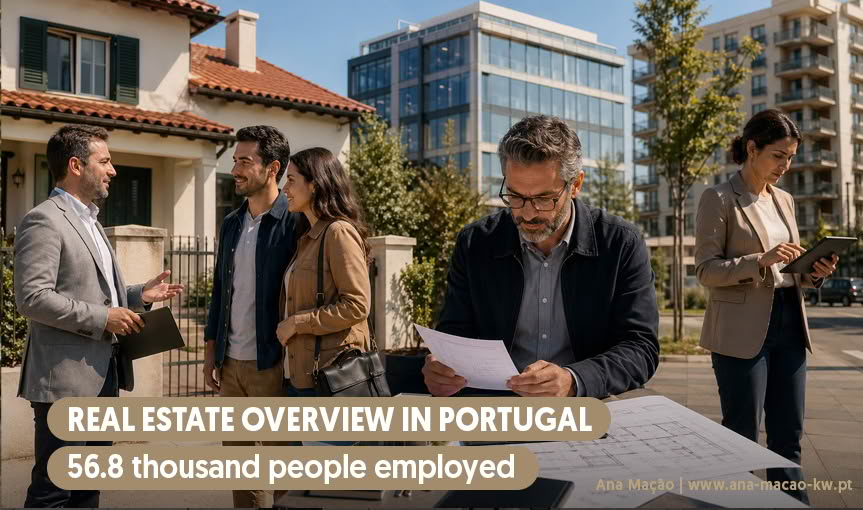
The real estate sector is often viewed solely through the lens of brokerage, but the real picture is broader. In Portugal, official statistics include brokerage, valuation, property management and activities related to buying, selling and renting. In 2025, there were 56.8 thousand people employed in real estate activities; in 2024, the sector comprised 67,912 companies and 98,882 persons employed. The European sector had 2.7 million people employed and 1.6 million companies in 2022.
| Area | Indicator | Value | Useful reading |
|---|---|---|---|
| Portugal | People employed in real estate activities | 56.8 thousand in 2025 | Direct snapshot of sectoral employment |
| Portugal | Companies in the sector | 67,912 in 2024 | Highly fragmented structure |
| Portugal | Persons employed by companies | 98,882 in 2024 | Operational scale of the sector |
| European Union | People employed | 2.7 million in 2022 | European scale of the sector |
| European Union | Companies | 1.6 million in 2022 | Dispersed sector |
Table sources: PORDATA/INE and Eurostat.
| Role | Main tasks | International employment benchmark |
|---|---|---|
| Agents and brokers | Prospecting, pricing, listings, marketing, viewings, offers, negotiation | 532,200 jobs in 2024 in the USA, including 111,300 brokers and 420,900 sales agents |
| Property managers | Contracts, collections, maintenance, incidents, reporting, relationships with residents and owners | 466,100 jobs in 2024 in the USA |
| Appraisers | Visits, photography, comparable analysis, databases, reports, technical valuation reports | 77,300 jobs in 2024 in the USA |
Table source: U.S. Bureau of Labor Statistics.
A brief chronology of AI
AI did not appear suddenly; it evolved in layers, with a growing impact on professional life:
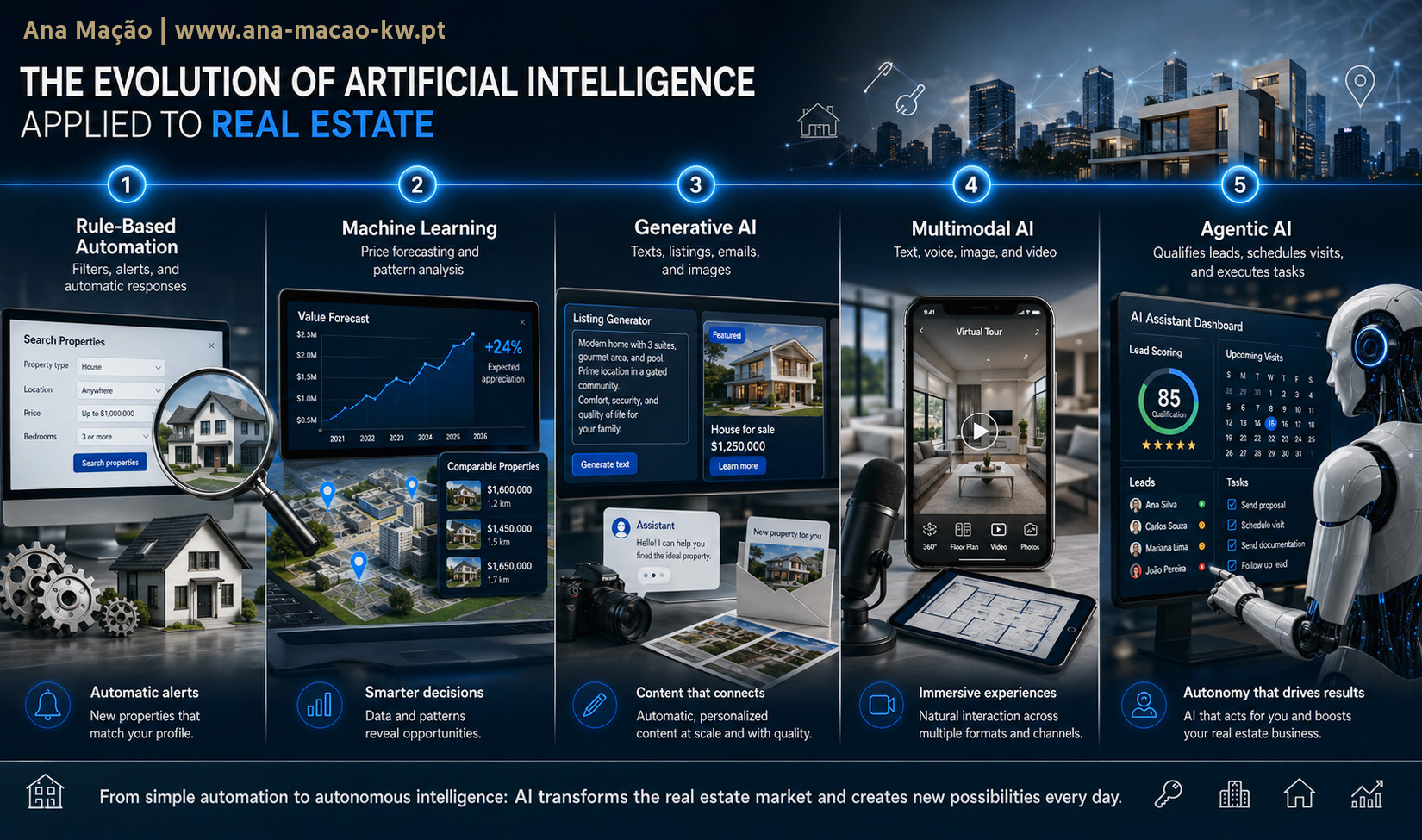
- Rule-based automation: software that performs repetitive routines, such as search filters and pre-programmed replies, has existed for decades.
- Machine learning: systems capable of improving predictions based on data and identifying patterns, useful in price estimates or customer segmentation.
- Language models and generative AI: tools such as ChatGPT make it possible to create text, videos and images, summaries, translations and adverts. This technological wave is already being felt in the daily tasks of a real estate consultant.
- Multimodal AI and Agent Mode: on the rise, this technology makes it possible to combine text, voice, image and video to execute complete processes, such as qualifying leads, scheduling viewings or preparing reports, through a team of agents working in a synchronised and autonomous way.
- Quantum AI and superintelligence: still experimental, these technologies could revolutionise real estate consulting. From real-time market simulation, anticipating price fluctuations, to predictive urban planning capable of identifying areas of appreciation before any infrastructure announcement. At the peak of this evolution, superintelligence will process millions of variables — demographics, legislation, climate, mobility — to match the ideal property with the right client, exceeding human analytical capacity in a scenario that, until now, belonged to science fiction.
This chronology helps explain why administrative and repetitive tasks are the first to be automated, while activities involving human contact require a different kind of approach.
Real Estate 4.0: where AI is already making its mark
The most direct way to talk about AI in real estate is to show where it is already entering the sector. This is not just about “a chatbot on the website”. Today we already have LLMs and chatbots for customer service and initial responses, CRM systems with lead scoring to prioritise contacts, document automation, AVMs for value estimates, virtual tours and AI-assisted visual content, and predictive analytics for reporting, risk and operations. In practice, AI is gaining ground wherever there is data, text, repetition and workflow.
| Technology | Concrete example | What changes at work |
|---|---|---|
| Chatbots and LLMs | They serve clients 24/7, answer frequently asked questions, generate property descriptions and carry out initial lead screening | Reduces repetitive customer service volume and speeds up first contact |
| CRM with automation | They classify contacts, segment clients and trigger automatic emails | Removes manual work from basic prospecting and pipeline organisation |
| Document automation | Electronic signature, version management, document sending and archiving | Shortens the transactional and administrative component |
| AVMs | They use historical comparables and geographic data to estimate property values in seconds | Speeds up standardised valuations and “desktop valuations” |
| Virtual tours and imagery | 3D tours, drone video, visual content for pre-qualification | Fewer initial trips and better filtering of interest |
| Predictive analytics | They detect anomalies, integrate data sources and automate reports and presentations | Greater speed in reporting, planning and decision support |
Table notes: NAR shows the strong adoption of eSignature, social media, drone and generative AI in brokerage; JLL identifies use cases in data standardisation, anomaly detection, data integration and report automation; RICS explains that many modern AVMs use machine learning and that chatbots/copilots are already real use cases in professional practice.
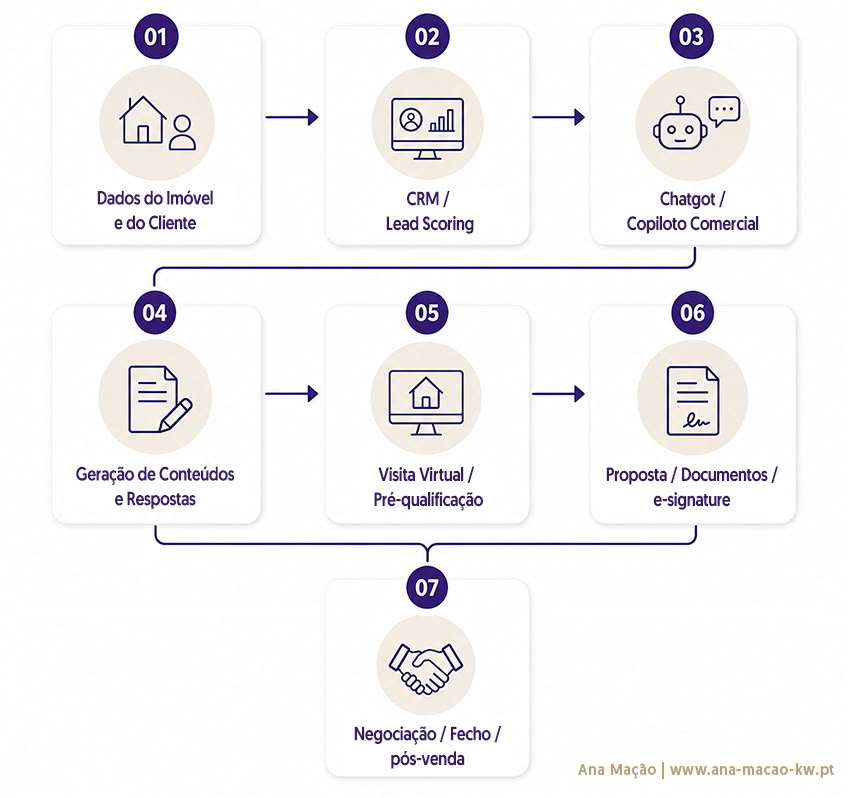
At a technological level, Deloitte’s Commercial Real Estate Outlook 2024 study indicates that 76% of commercial real estate companies are already exploring or implementing AI solutions, and that the global AI in real estate market could grow from 222.65 billion dollars in 2024 to 988.59 billion in 2029. These trends confirm that digitalisation is an unavoidable reality.
According to the National Association of REALTORS®, in 2025 the tools most used by North American agents were electronic signature (79%), social media (75%), drone photography and video (52%) and AI-generated content (46%). These figures show that technological adoption is not a distant phenomenon.
For me, these are the main ways in which AI is simplifying my day-to-day work in 2026:
- Communication: Support in writing, translating and optimising emails, using Gemini integrated into Gmail;
- Multilingual translation: Translation of documents and support in communicating with international clients;
- Smart digitisation: Conversion of images and physical documents into editable text through OCR using ChatGPT;
- Listing creation: Creation of texts, images and promotional videos for property listings; production of images based on real photographs or architectural projects for off-market promotion; virtual home staging, etc.;
- Marketing: Support for marketing activity through the creation of video scripts, editorial content, images and promotional videos;
- Smart market analysis: Transformation of raw data from Casafari and InfoCasa into personalised reports or interactive web pages using AI. The aim is to replace generic models with more rigorous pricing advice tailored to each property, combining technology, data and market insight;
- Smart Qualification Pipeline: Automatic screening and qualification of leads from social campaigns (Meta), with the generation of financial, personal and professional reports through integration between Google API and Kimi;
- Other applications: Additional support in commercial, operational and marketing processes related to real estate brokerage.
Who is most exposed to automation?
One way to understand the impact of AI is to analyse roles and their respective tasks. Based on Bureau of Labor Statistics descriptions and ILO statistics for office work, we can identify areas at greater risk of automation:
- Administrative and transactional support: data entry, document verification and process follow-up are highly automatable.
- Operational marketing: the production of routine texts, emails and database segmentation has high exposure.
- Property managers and appraisers: some tasks, such as maintenance scheduling, report updates and simple valuations, can be carried out by AI.
- Real estate consultants: lead screening, property descriptions and agenda organisation can be automated, but trust, negotiation and local knowledge continue to require human intervention.

The central message is clear: human-contact and complex-analysis roles remain resilient, while administrative routines will increasingly be delegated to machines.
Expected impact on real estate employment
Below you can consult some reports from organisations that attempt to forecast the impact of AI on employment.
| Source | Key figures | Useful reading |
|---|---|---|
| OECD | 9% of jobs automatable; 27% in higher-risk occupations | Less “end of professions”, more uneven pressure by type of task |
| OECD | 6% growth in high-risk occupations vs. 18% in low-risk occupations | Technology does not destroy everything, but it slows vulnerable roles more |
| ILO | 1 in 4 workers has some degree of exposure to GenAI | Broad transformation, not just isolated cases |
| ILO | 24% of back-office tasks at high exposure and 58% at medium exposure | Real estate back office is the most fragile area |
| McKinsey | 27% of hours worked in Europe could be automated by 2030 | This decade is decisive for redesigning roles |
| WEF | 170 million jobs created, 92 million displaced, 39% of skills changing | The greatest risk may be allowing skills to become outdated |
Table sources can be consulted through the links in the “Useful reading” column.
When the machine does not replace the human being
Buying or selling a home is, above all, an emotional decision. AI processes data, but it does not interpret the silence of a couple during a viewing or the anxiety of a family negotiating the sale of an inheritance.
Among consultants who work in the mid-high and luxury segment, as I do, trust and empathy continue to carry more weight than algorithms; however, I would say that this concern, given the substantial investment a buyer has to make when purchasing a home, extends to the remaining segments as well.
Therefore, the question is not whether AI will replace the consultant, but which tasks will be automated and which will remain human. The International Labour Organization estimates that 1 in 4 workers has an occupation exposed to generative AI, although in most cases roles will be transformed rather than eliminated.
Strategies to remain relevant in real estate
At a time when AI technologies are increasingly accessible and widespread, consultants who wish to remain competitive should invest in their professional development and in acquiring or improving skills:
- Digital and AI literacy: mastering how CRM platforms work, knowing how to configure a chatbot or using generative AI tools to write descriptions and reports is already part of the professional profile.
- Strengthened human skills: negotiation, empathy, critical thinking, interpretation of local contexts and personalised support. According to the World Economic Forum, skills on the rise include analytical thinking, creative thinking and lifelong learning.
- Specialisation in niches: building authority in a specific area or segment — luxury, investment, rental — where trust and local knowledge are decisive.
- Validation and ethics: learning to verify the outputs produced by AI, ensuring compliance with the General Data Protection Regulation (GDPR) and IMPIC rules, and making sure algorithms do not reproduce “AI hallucinations” or unwanted biases.
- Learning from the international community: many national and foreign institutions regularly publish reports, articles and studies. Below you can consult some of these sources.
| Skill to strengthen | Source / institution | What to consult | How it helps consultants stand out in the age of AI |
|---|---|---|---|
| Ethics, trust and professional responsibility | CEPI - European Code of Conduct | European code of conduct and ethical behaviour for real estate professionals. | AI can generate answers, but it does not assume professional responsibility or replace the trust built between consultant and client. Mastering ethical principles reinforces transparency, confidentiality and the management of conflicts of interest. Consult. |
| Professional conduct, competence and responsible use of technology | RICS - Rules of Conduct | Rules of professional conduct, practical examples, case studies, ethics, competence, customer service and responsible use of data and technology. | Helps consultants understand that technology must be used with judgement, transparency and responsibility. This is an essential skill for distinguishing professional advice from simple automated responses. Consult. |
| Brokerage, agency and service standards | RICS - Real Estate Agency and Brokerage | Professional standards applicable to the sale, rental, leasing and management of properties. | Helps consultants structure their service better, clarify responsibilities, protect the client and demonstrate that real estate brokerage is a professional activity with method, rules and duties, not merely a property promotion function. Consult. |
| Real estate negotiation | RICS Online Academy - Sales and Negotiation | Training in commercial negotiation, active listening, win-win approaches, persuasion and managing relationships with buyers and sellers. | Negotiation requires emotional reading, contextual interpretation, objection handling and the ability to build trust between parties. These are human skills where a well-prepared consultant continues to have a clear advantage over AI. Consult. |
| Advanced negotiation and difficult conversations | Harvard Law School - Program on Negotiation | Training in negotiation techniques, value creation and claiming, emotion management, simulations and difficult conversations. | Helps consultants prepare negotiations methodically, anticipate points of tension, defend the client’s interests and conduct complex conversations with greater confidence. Although it is not a real estate source, it is highly useful for a critical cross-cutting skill. Consult. |
| International clients and global network | FIABCI - International Real Estate Federation | International network of real estate professionals, best practices, events, global knowledge and contact with different market realities. | Helps consultants better understand foreign clients, cultural differences, international trends and cross-border opportunities, strengthening a relational and strategic dimension that AI alone cannot replace. Consult. |
| European foundational training for real estate professionals | CEPI - Eureduc Programme | European reference programme for the training of real estate agents and property managers. | Helps consultants compare their preparation with European training benchmarks, making it possible to identify gaps in areas such as law, taxation, valuation, urban planning, finance, technology and professional management. Consult. |
| Residential specialisation | RICS - Certificate in Residential Real Estate | Training on residential property valuation, inspection, measurement, maintenance, rental and residential property management. | Strengthens the consultant’s ability to analyse a property with greater technical depth, going beyond commercial description or automatic price comparison. Consult. |
| Residential sales and customer service | Propertymark Qualifications - Property Sales | Qualifications in residential sales, the role of the real estate professional, customer service, marketing, safety and legal framework. | Although rooted in the British context, it is a useful reference for strengthening commercial method, organisation of the sales process and the quality of service provided to the client. It should be used as technical inspiration, not as a legal reference for Portugal. Consult. |
| Real estate valuation and international standards | IVSC - International Valuation Standards | International valuation standards, principles of consistency, comparability, transparency and professionalism in determining value. | Helps consultants distinguish asking price, market value, perceived value and the risk of overvaluation. This ability to interpret value with judgement is one of the strongest ways to differentiate themselves from automated analyses. Consult. |
| Pricing advice and technical justification | RICS - Red Book Global Standards | Global valuation standards, best practices, assumptions, justification and reporting. | Allows consultants to improve the quality of comparative market studies, explaining prices based on technical criteria, evidence, prudence and local context. Consult. |
| Urban interpretation, development and investment | Urban Land Institute - ULI Learning | Courses on real estate development, investment, finance, sustainability, housing, cities and land use. | Helps consultants frame each property within its territory: accessibility, centralities, urban regeneration, future supply, lifestyle, risks and appreciation potential. Consult. |
| Strategic real estate trends | PwC / ULI - Emerging Trends in Real Estate | Reports on real estate trends, investment, risk, cities, technology, sustainability and market behaviour. | Improves the ability to anticipate sector movements and explain to clients what may influence demand, price, liquidity and buying or selling decisions. Consult. |
| Customer experience | Harvard Business School Online - Transforming Customer Experiences | Course on experience design, service, customer relationships, loyalty and competitive advantage. | Helps consultants design a clearer, more human and more memorable buying or selling experience, from first contact to after-sales. Customer experience is an area where empathy and care remain decisive. Consult. |
| Artificial intelligence literacy | DeepLearning.AI - Generative AI for Everyone | Introductory course on generative AI, its potential, limitations, use cases and impact on work. | Allows consultants to use AI as an assistant without giving up critical judgement, information validation, professional ethics and the human relationship with the client. Consult. |
| AI strategy applied to business | MIT Sloan Executive Education - Artificial Intelligence: Implications for Business Strategy | Programme on the impact of AI on strategy, productivity, teams, processes and organisational transformation. | Helps consultants or real estate teams understand where AI creates efficiency and where human intervention remains indispensable: decision-making, relationships, negotiation, reputation and professional responsibility. Consult. |
| Digital marketing and results measurement | Google Skillshop | Training in Google tools, digital advertising, search, video, measurement and digital skills. | Helps consultants better understand lead generation funnels, search intent, segmentation, adverts, metrics and campaign returns, avoiding blind dependence on automated platforms. Consult. |
| Content marketing and professional authority | HubSpot Academy - Content Marketing Certification | Course on content strategy, storytelling, SEO, editorial planning and conversion. | Helps consultants create content that educates clients, demonstrates local knowledge and builds trust. In an AI-driven market, personal authority becomes more important than simply producing generic texts. Consult. |
| Sustainability, efficiency and ESG | World Green Building Council - Reports | Reports on sustainability in the built environment, decarbonisation, energy efficiency, health, comfort, resilience and circular economy. | Helps consultants add value to topics that are increasingly relevant to buyers and investors: energy certificates, thermal comfort, running costs, renovation, sustainability and the property’s future risk. Consult. |
| International comparison of prices and affordability | OECD - Housing Prices | International indicators on house prices, rents, price-to-income and price-to-rent ratios. | Helps consultants frame Portugal within the international context and explain trends in appreciation, household effort, affordability and price sustainability. Consult. |
| European housing data | Eurostat - Housing Price Statistics | European statistics on house prices, rents and residential indicators. | Makes it possible to compare the Portuguese market with other European markets, avoiding analyses based only on perceptions, isolated news or overly local interpretations. Consult. |
| National housing data | INE - Construction and Housing | Indicators on prices, rents, transactions, licensing, construction, bank valuations and the evolution of the housing market in Portugal. | Helps consultants support local analyses with official data, strengthening the owner’s confidence in pricing advice and sales strategy. Consult. |
| Credit, interest rates and purchasing power | Banco de Portugal - BPstat Housing Credit | Statistics on housing credit, new operations, loan stocks, interest rates, index rates and instalments. | Helps consultants understand the impact of financing on demand, purchasing power, buyers’ speed of decision and the market’s sensitivity to interest rates. Consult. |
| Regulation and trust in the Portuguese market | IMPIC | Official information on real estate brokerage, licensing, licensed companies, regulation, circulars, technical guidance and sector obligations. | Strengthens knowledge of sector rules and enables consultants to convey security, legality and transparency to clients. Regulatory trust is a human and professional advantage that AI cannot replace. Consult. |
| Professional training in Portugal | Academia APEMIP | Courses and training content aimed at real estate brokerage professionals in Portugal. | Helps adapt international best practices to the Portuguese reality, focusing on the legal framework, commercial skills, new technological requirements, responsibility and service quality. Consult. |
Conclusion: the Chicago lesson revisited
In 1886, Chicago workers did not fight against machines, but against the unfair way in which they were used. Today, AI is a powerful tool that can free consultants from bureaucratic tasks, allowing them to focus on what makes them irreplaceable: listening, advising and negotiating with empathy.
The professional who refuses to adapt will be overtaken — not by the machine, but by the colleague who has learned to use technology as an ally.
So, as we celebrate Labour Day, let us also celebrate our ability to reinvent ourselves. AI will not destroy the profession of real estate consultant; it will transform it, demanding curiosity, continuous learning and humanity.