

For many years, the ideal home was sold as synonymous with space. We all remember what the preferred requirements were: large living room, generous bedrooms, wide hallway, separate kitchen, storage, garage, and, if possible, an "extra" room for whatever was needed.
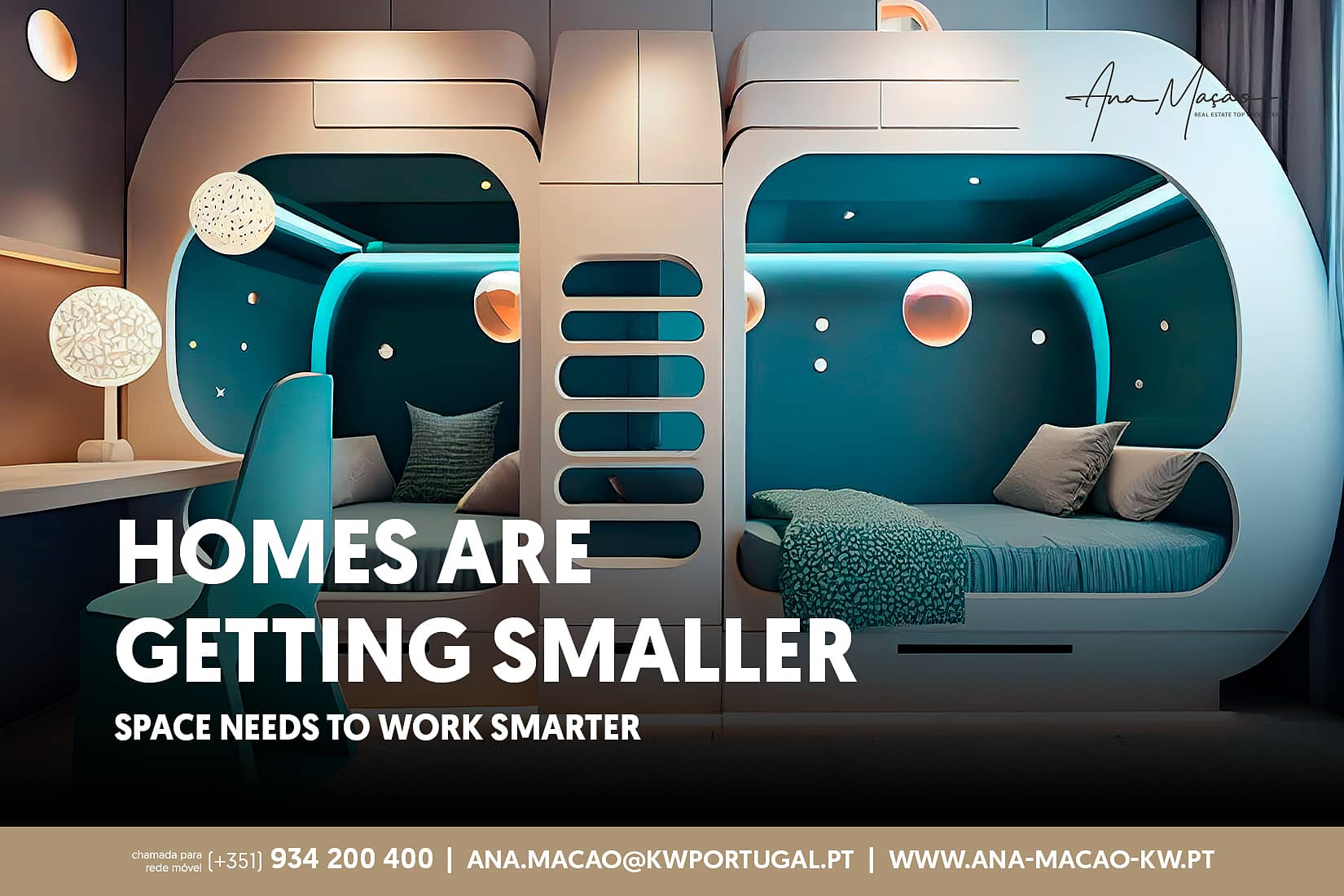
But reality has changed. In large urban areas, where land is increasingly expensive and construction costs keep rising, access to purchasing has become more difficult and the "house has stopped growing." In many cases, it has shrunk.
The question is no longer just “how many square meters does it have?”. More and more, the right question is: “how can these square meters be lived in?”
The cost of construction has changed the shape of the house
The reduction in areas is not unique to Portuguese architecture and did not happen by chance. Nor does it result from an aesthetic trend or a new passion for minimalist houses, there is a very concrete reason: building has become more expensive.
In recent years, construction costs have risen significantly, both in Portugal and the rest of Europe. Labor has become scarcer and more expensive, materials have experienced strong fluctuations, energy demands have increased, and projects now have more technical, environmental, and regulatory requirements.
According to Eurostat, the construction costs of new housing in the EU rose by about 48% between 2015 and 2025. In Portugal, INE records continuous increases, mainly pressured by labor. After moderate increases until 2020, costs skyrocketed in the national market, with a jump of 12.2% in 2022 and growths in the order of 4% to 4.5% in 2024 and 2025.
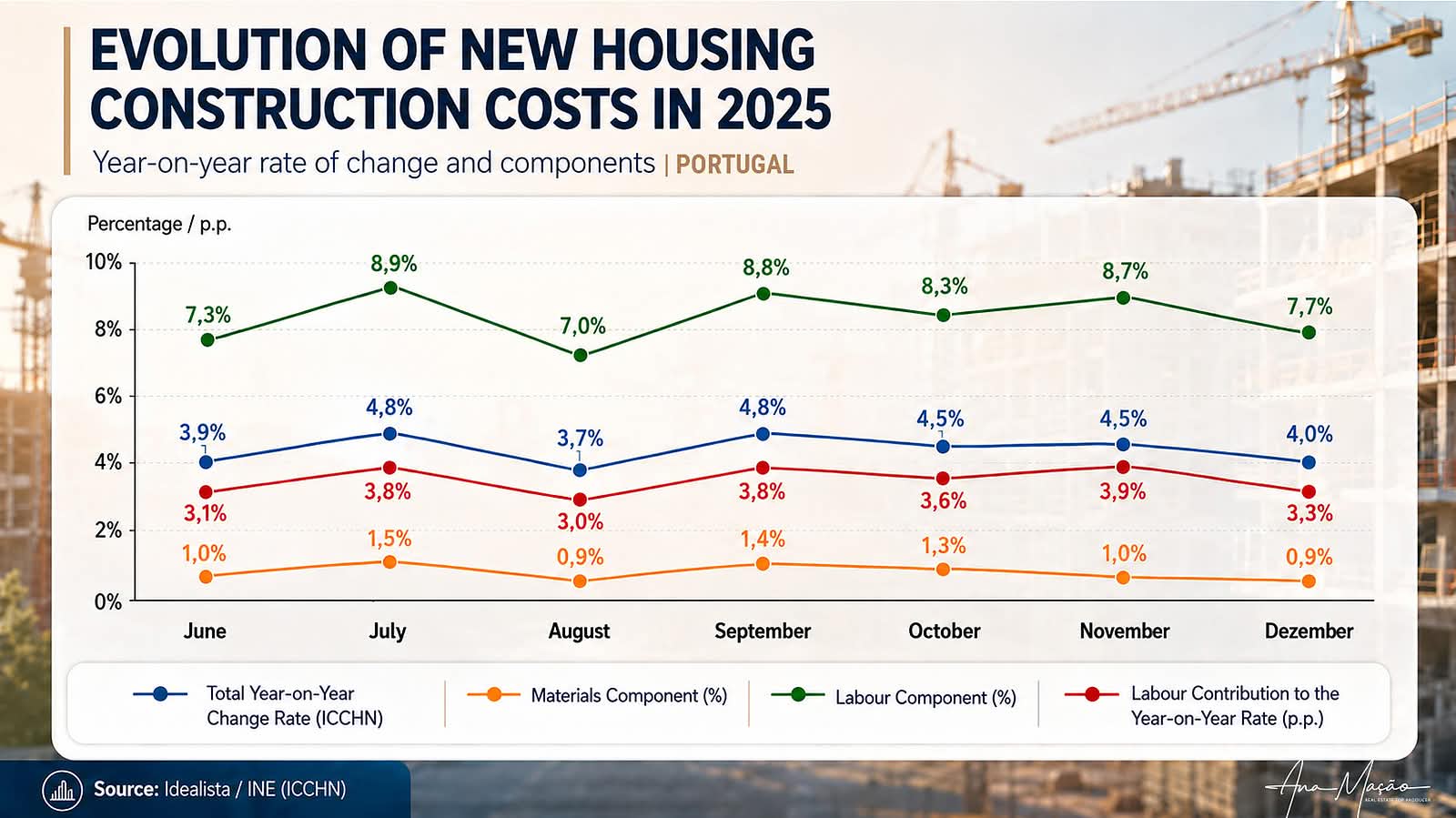
When the cost per square meter rises, the market reacts and one of the recurring ways to keep the final price of houses within minimally acceptable limits is to reduce the area of the houses.
In practice, many developers are not just building smaller houses because the buyer wants to live with less space, and there are cases where this happens. They are doing it because if they maintained the usual areas, the final price would simply be out of reach for an even larger part of the market.
Less area, but not necessarily a worse house

A smaller house is not, in itself, a worse house, but there are bad examples, no doubt. There are old apartments with generous areas but poorly distributed: long corridors, dead zones, an excess of small rooms, closed kitchens with no relation to the living room, difficult-to-furnish bedrooms, and improvised storage.
On the other hand, there are more compact apartments that work very well because they were intelligently designed: fewer corridors, more natural light, integrated storage, an open kitchen to the social area, custom furniture, and rooms capable of serving multiple functions.
The problem is not in the size. It's in the poor use of space.
A well-designed 80 m² T2 apartment can be more pleasant and functional than a poorly distributed 105 m² T2. And this is a difference that those who visit houses quickly feel, even if they cannot always explain it in technical terms.
The house now has to "do more things"

A decade ago, the house was mainly the place where one rested and slept after work. Today, for many people, the house is also an office, gym, study room, leisure space, dining area, emotional refuge, and sometimes a permanent workplace.
The pandemic accelerated this change, but it was already underway. Teleworking, hybrid schedules, rising city prices, and the need to make better use of every square meter have forced adaptation by developers and architects.
Therefore, spaces began to be thought of differently:
- The living room is no longer just a living room. It can include a discreet work area, an extendable table, a reading corner, or a storage solution that also functions as a visual separator.
- The bedroom is no longer just a bedroom. In many cases, it needs to integrate more efficient wardrobes, a desk, adequate lighting, and some sound insulation capacity.
- The kitchen, especially in newer homes, is no longer a hidden division. It has become part of the house's social life, integrated with the living room, more open, more visible, and also more demanding from an aesthetic point of view.
The big cities push us towards more compact houses

Lisbon, Porto, Oeiras, Cascais, and other urban areas with strong demand experience very particular pressure.
The urban land available for construction is increasingly scarce, and its price continues to rise, permits are complex and time-consuming, and demand remains high. In these markets, every square meter counts. On the other hand, more and more elderly people live alone, and families with only one child have increased, hence the growth in demand for smaller and easier-to-manage houses.
That is why in the most valued urban areas, there is an increasing focus on compact T0, T1, T2, and apartments with small but well-maintained outdoor areas. An 8 m² balcony, when well-oriented and well-presented, can have more emotional impact than an interior space poorly utilized.
The urban buyer has become more pragmatic and receptive to compromises. They may be willing to accept less area, provided the location compensates, transport is nearby, the house is efficient, and the interior layout works.
The issue is that this balance is delicate and risky from the developer's point of view. There is a huge difference between a compact house and a cramped house. The first is intelligent when balanced. The second is just small.
In smaller cities, space still matters differently

Outside the major metropolitan areas, the conversation changes. In medium-sized cities and smaller towns, land prices tend to be lower, and the pressure of demand is different. This allows, in many cases, the construction of houses with more generous areas, homes with outdoor space, larger garages, and less cramped rooms.
The increase in demand in these areas is not unrelated to these factors, with a greater impact from immigrant buyers, who have less attachment to their native region. But even there, this trend does not go unnoticed.
Construction costs are national and affect all territories. Labor, materials, energy requirements, technical specialties, and construction timelines weigh as much on an apartment in Lisbon as on a house in the interior, even if the land has very different prices.
Therefore, even in smaller towns, there is increasing attention to floor plan efficiency. Less wasted area, more storage, more social kitchens, more contained suites, and outdoor spaces designed for real use, not just to appear in the property description.
The European trend: living with less, but living better

Portugal is not alone in this transformation. In major European cities, rising prices, lack of supply, and changing lifestyles have led to a profound revision of how housing is designed.
In Paris, Madrid, London, Amsterdam, Berlin, or Milan, the last decade has brought greater acceptance of compact apartments, co-living solutions, student residences, build-to-rent, transformable furniture, and less conventional floor plans.
Eurostat clearly shows this difference between territories: in European cities, the majority of the population lives in apartments, while in rural areas, houses clearly predominate. In other words, urban density directly influences the type of housing available.
Europe is also increasingly discussing housing quality, not just its quantity. A small house can be adequate if it has light, ventilation, insulation, storage, and flexibility. But it becomes problematic when the reduction in area compromises privacy, rest, work, or family life.
The end of the “catalog” division

One of the most interesting changes in recent years is the flexibility in the architecture of interior spaces.
For a long time, each room had a very defined function: living room for entertaining, kitchen for cooking, bedroom for sleeping, office for working. Today, that logic is a bit more fluid.
Smaller houses require thinking in layers of use:
- A table can serve for meals, work, and homework.
- A bench can hide storage.
- A bookshelf can separate environments without closing the division.
- A foldable bed can transform a guest room into an office.
- A balcony can be a reading area, a small garden, an extension of the living room, or a dining space.
This flexibility does not mean living in permanent improvisation. On the contrary: it requires more design, more planning, and better choices.
The smaller the house, the less room there is for errors.
What is being valued in a compact house?

When the area decreases, some elements become even more important.
- Natural light: a small house with good light always seems larger.
- Integrated storage: closets, custom furniture, and hidden storage areas prevent the feeling of chaos.
- Simple floor plan: fewer corridors and fewer dead zones mean more usable space.
- Good acoustics: essential when the house also serves for work or study.
- Functional balconies: even small ones can add quality of life. The square format gains importance over the rectangular one.
- Well-designed kitchens: in a compact house, the kitchen must be beautiful, practical, and easy to maintain. Preferably open to the living room to maximize spatial perception.
- Proportional furniture: overly large furniture makes a small house seem even smaller.
In my real estate mediation experience, I realize that, often, buyers do not automatically reject smaller areas. They reject houses where they cannot imagine their daily routine.
A well-thought-out floor plan helps the buyer understand where they work, where they store, where they entertain friends, where children play, or simply where life fits. There is no direct relationship between the architect's table and the buyer's mind. The concerns are of a different order, which sometimes complicates the logic and understanding of the space.
The risk: confusing efficiency with tightness

There is, therefore, an evident risk, the pressure of costs may lead some projects to reduce areas to the limit of acceptability, selling as "efficiency" what is simply a lack of space.
A compact house should still allow comfortable circulation, storage areas, minimum privacy, space to cook, rest, and entertain. But when everything depends on overly ingenious solutions, the house can become tiring day-to-day.
Not all families live the same way. A compact 1-bedroom apartment can work very well for a single person or a young couple. But it can be clearly insufficient for a family with a child, telework, and storage needs.
Therefore, the discussion should not be just about square meters. It should be about adequacy.
The right question is: does this house truly serve the life of those who will inhabit it?
The market is also changing how space is sold

Real estate communication must keep up with this change. For years, it was enough to highlight the gross area, typology, and location. Today, especially in more compact houses, it is essential to explain the logic of the space.
- It's not enough to say that the living room has 22 m²: it's necessary to show that it allows for a living area, dining table, and natural connection to the kitchen.
- It's not enough to say that there is a balcony: it's necessary to show how it can be used. Virtual rendering can help in this process.
- It's not enough to photograph an empty bedroom: it's necessary to help the buyer understand the scale, circulation, and storage. 3D floor plans help in this process.
In small houses, presentation is decisive. A poor choice of furniture, a poorly framed photograph, or an excess of objects can make the property seem smaller than it really is.
On the contrary, when the space is well prepared, photographed, and explained, the house gains clarity. And clarity sells.
Legal limit: what the RGEU says about how small a house can be
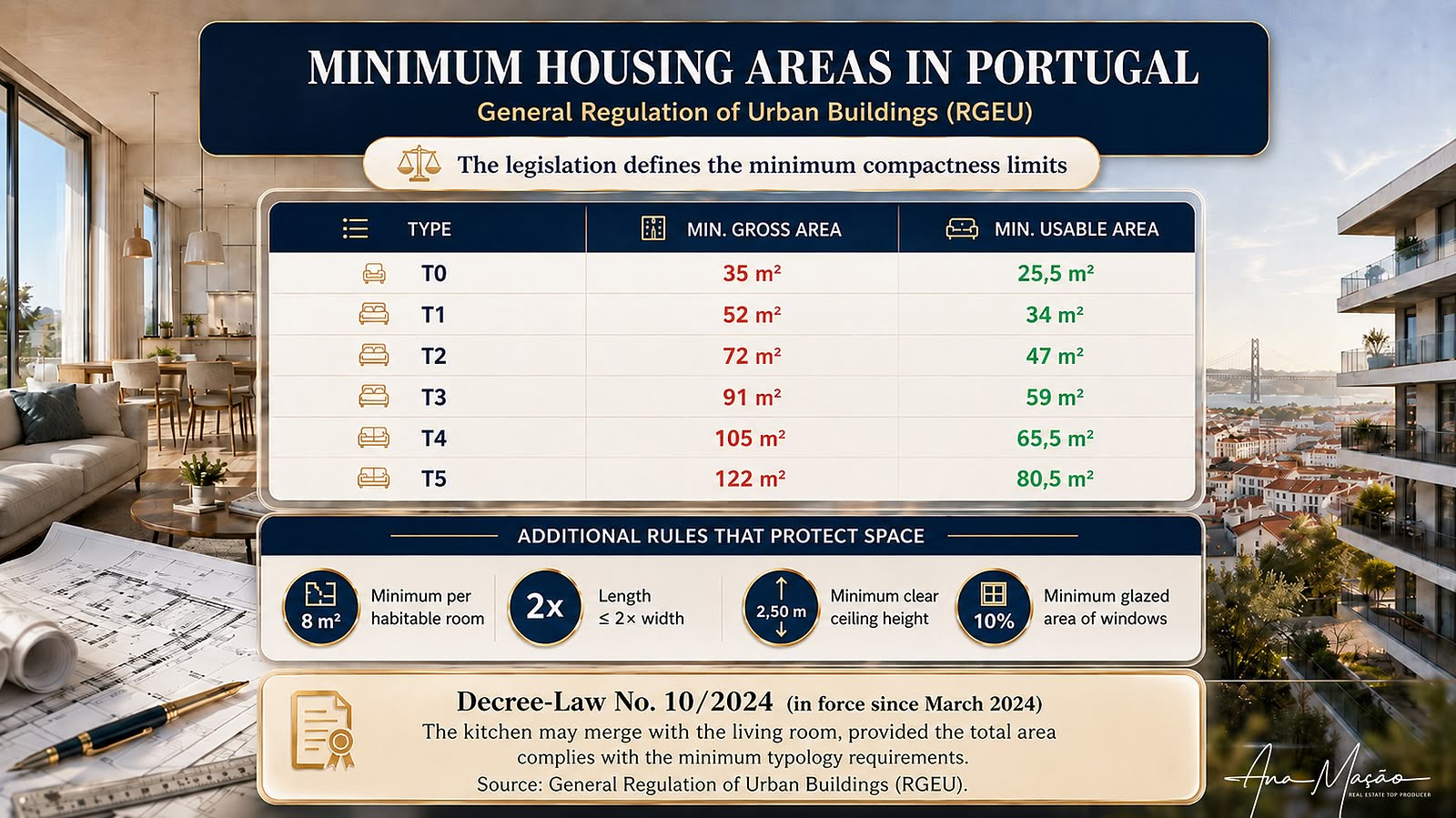
The General Regulation of Urban Buildings (RGEU) establishes minimum gross areas: T0: 35 m², T1: 52 m², T2: 72 m², etc. Additionally, no room can have less than 8 m² of usable space, and there are strict geometric rules (proportions, minimum diameters of inscribed circles, ceiling height):
The house of the future may be smaller, but it will have to be better
The reduction in areas should not be seen only as a loss, it can also be an opportunity to design better, waste less, and create homes more adapted to real life.
But there is a line that cannot be ignored:
A well-thought-out small house can be comfortable, efficient, and even surprising. A poorly designed small house is just a limitation wrapped in elaborate speech.
The future of housing, especially in large urban areas, will inevitably involve more compact spaces. But this requires developers, architects, mediators, and buyers to be more demanding.
Less area only makes sense if there is more intelligence. Because a good house is not measured only in square meters. It is measured by how it allows living, resting, working, entertaining, storing, breathing, and feeling that, despite everything, there is room for life to happen.