

For decades, the Portuguese real estate market developed around a simple idea: build to sell. The developer would develop a project, market the apartments, and move on to the next project.
But the reality of housing has changed: purchase prices have risen, access to credit has become more demanding for many families, and a growing portion of the population is seeking long-term rental solutions.
In this context, a concept already established in several countries is finally gaining ground in Portugal: Build to Rent.
The expression may seem like another trend imported from the Anglo-Saxon world, but the truth is that it can address a very real problem: the lack of rental housing supply at affordable prices.
What exactly is Build to Rent?

The concept is relatively simple. Instead of building apartments for individual sale, the developer builds the entire development, or part of it, with the aim of keeping it operational through leasing.
In other words, the building is conceived to be rented from the start. The management, maintenance, tenant relations, and property operation are usually handled by a professional entity.
This model is common in countries like the United Kingdom, Germany, the United States, or the Netherlands, where there is a much more established rental culture than in Portugal.
In practice, investors trade the immediate profit from sales for income generation over many years.
Why is it gaining relevance in Portugal?

The Portuguese market continues to be dominated by homeownership:
According to the latest data from Eurostat, in Portugal, about 74% of the population lives in their own home.
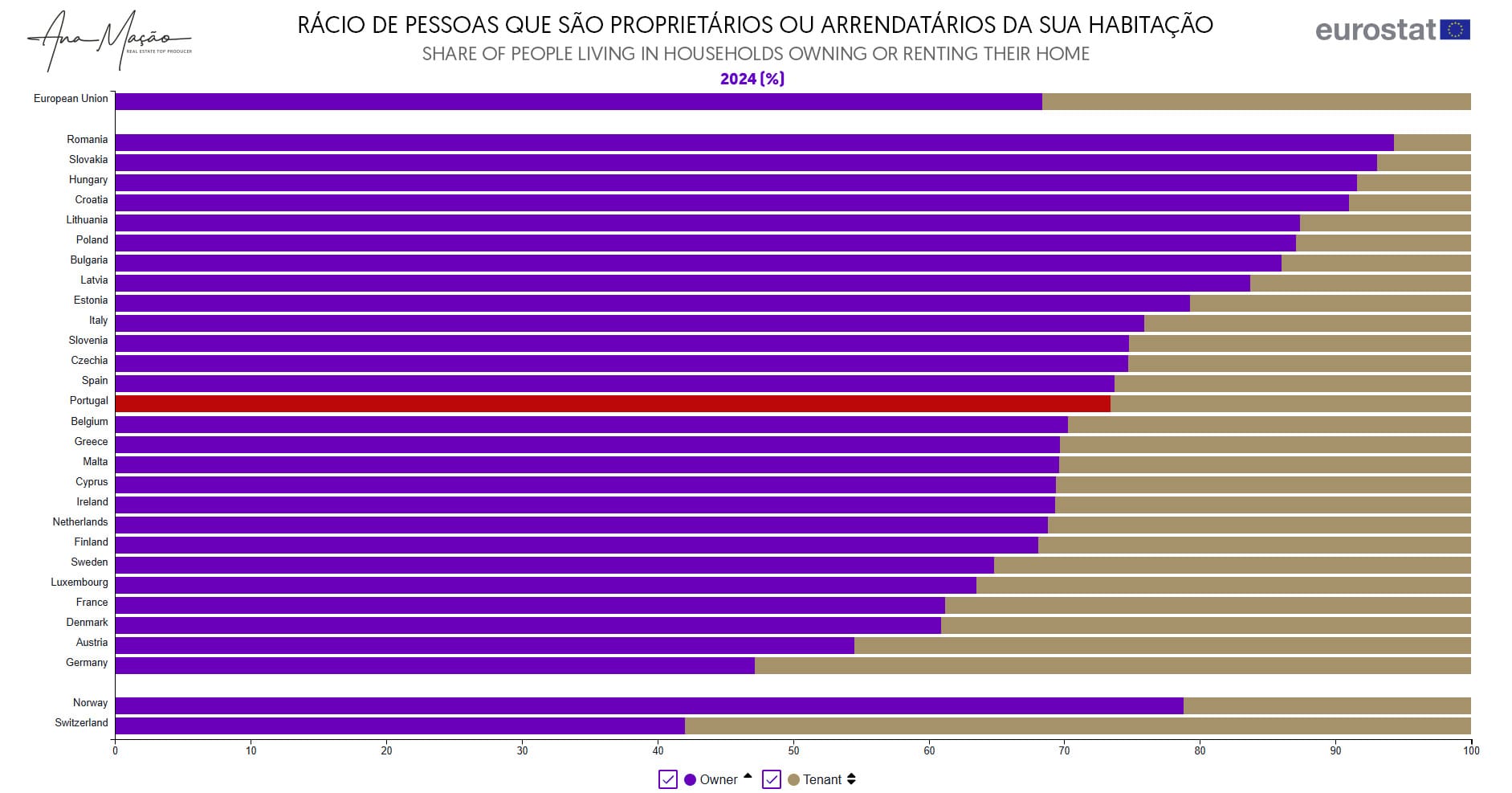
But the reality is changing... The issue is that currently, many young professionals prefer to maintain geographical flexibility. Others cannot gather enough capital to buy a house. There are also international workers, families in transition, and people who simply choose not to commit to a financial obligation that could last their entire professional life.
At the same time, the rental supply remains insufficient in many urban areas, particularly in the metropolitan areas of Lisbon and Porto.
The practical result we all know: little supply, high demand, and high rents.
Build to Rent emerges precisely to try to increase the number of houses available for rent structurally.
Oeiras Tech City: one of the largest examples in Portugal

One of the most relevant cases is precisely in Oeiras, the municipality where I reside and work.
The Oeiras Tech City project, promoted by RE Capital in partnership with REIG, envisions about 1,047 housing units, commercial spaces, services, and coliving units, with an investment exceeding 400 million euros, with about 40% of the built area intended for Built-to-Rent.
Located near Taguspark, the development was conceived as a new integrated urban neighborhood, benefiting from proximity to one of the largest technological and business hubs in the country.
More importantly, RE Capital has clearly adopted a strategy oriented towards the Build to Rent model, a still uncommon bet in the Portuguese market.
The project represents a paradigm shift: instead of creating just another set of apartments for sale, it seeks to develop a residential ecosystem designed to meet the new needs of mobility, work, and housing of the urban population.
Porto is already advancing

If Oeiras represents a large-scale private investment, Porto is testing a solution that combines private investment and public objectives.
The Jardins do Oriente development, in Campanhã, is considered the first major Build to Rent project in the country.
It results from a partnership between the Municipality of Porto, the Ageas Group, and the construction company Garcia Garcia, with the construction of 151 housing units planned.
Of the total, 124 units will be allocated to the municipal affordable rental program for an initial period of ten years, which can be renewed.
The planned rents are well below the values practiced in the local market for equivalent types.
The interest of this project goes beyond the numbers. It shows that Build to Rent can function as a housing policy tool without relying exclusively on traditional public construction.
The national scenario is starting to gain scale...
Although most of these large projects are confined to the major urban areas of Lisbon and Porto, their success could catalyze other Built-to-Rent developments in other large cities.
| Development | Location | Developer / Model | Planned Size | Phase / Deadline | Relevance |
|---|---|---|---|---|---|
| Oeiras Tech City | Oeiras, Greater Lisbon | RE Capital and REIG; mixed-use residential development with housing, coliving, commerce, and services. | 1,047 units; 11 buildings; 400 million euros investment. 40% planned for Build-to-Rent | Initial urbanization phase; completion expected by the 4th quarter of 2030. | One of the largest residential projects under development in Portugal. A mixed project and not a pure Build-to-Rent. |
| Cartes Living | Campanhã, Porto | Sonae Sierra and Solive, in partnership with the Porto City Council, under the Porto com Sentido program. | 331 units, from T0 to T3 types, 2 buildings; announced investment of 55 million euros. | Completion expected by 2029. | The largest Build-to-Rent project in the country and an example of a public-private partnership applied to affordable rental. |
| Jardins do Oriente | Campanhã, Porto | Ageas Group Portugal and Garcia Garcia, in partnership with the Municipality of Porto, through Porto Vivo, SRU. | 151 units: 124 for affordable rental and 27 in a standalone building for free rental. | Construction start expected in 2026; house delivery expected by 2028. | The 1st large-scale Build-to-Rent project in the country. An example of institutional investors' commitment to affordable rental. |
| Carvalhido BTR | Carvalhido, Porto | Sonae Sierra and Grupo Casais; private Build-to-Rent project, with industrialized construction and long-term professional management. | 200 units, from T0 to T2 types. | On-site construction expected in 2026; completion estimated by the end of 2027. | One of the clearest examples of private Build-to-Rent in Portugal, designed from scratch for long-term rental. |
| Project near the Wholesale Market | Campanhã, Porto, near Rua da Arada and Avenida de Cartes | Lusares – Sociedade Imobiliária, under a lease-promise contract with the Porto City Council, under the Porto com Sentido program. | 195 units in 2 residential blocks: 66 T0, 29 T1, and 100 T2, on a plot of about 22,400 m². | Execution period of 36 months; house lottery estimated for May 2029. | Shows how municipal Build-to-Rent can create affordable rental supply through private investment. |
| Palma Lofts | University City / São Domingos de Benfica, Lisbon | Coldwell Banker Luxus; urban rehabilitation oriented towards furnished and equipped rental. | 12 units, from T0 to T1 types, with areas between about 30 m² and 44 m². | Project launched and with progressive availability of units for rental. | Example of small-scale Build-to-Rent. Demonstrates that the model can also be useful in urban rehabilitation operations. |
Why do investors like this model?

At first glance, it may seem strange for a developer to forgo the immediate sale of apartments. But institutional investors have a different perspective.
Pension funds, insurers, and large investors often seek assets capable of generating stable income over decades.
A leased residential building can offer precisely that: predictable revenues, lower volatility, and protection against inflation.
Moreover, the housing shortage in many European cities significantly reduces the risk of a lack of demand.
For investors with long-term horizons, leasing can be as or more interesting than selling.
But are there risks?

Of course, there are. The main challenge remains profitability.
In cities where land is expensive and construction costs remain high, it becomes difficult to offer affordable rents without public support or tax incentives.
There is also regulatory risk. Investors tend to avoid markets where rules change frequently or where there is uncertainty about future rental limitations.
Therefore, many experts argue that the success of Build to Rent depends on the existence of a stable and predictable framework.
What are other countries doing?

Portugal is only taking its first steps in a trend that has already transformed several international markets.
United Kingdom - The United Kingdom is probably the most well-known European case. London, Manchester, Birmingham, or Leeds currently have tens of thousands of Build to Rent housing units in operation. Many of these projects include gyms, coworking spaces, common areas, digital services, and permanent professional management.
Germany - Germany has always had a strong rental culture. Much of the housing supply belongs to institutional investors and specialized companies, allowing for professional management and stable contracts.
Netherlands - Dutch authorities have been encouraging the construction of rental housing through collaboration programs between municipalities and private investors to quickly increase the available supply.
Spain - Right next door, in Madrid and Barcelona, there has been a growth of large Build to Rent projects supported by international funds. The goal is to address the growing difficulty of accessing homeownership for the middle class.
United States - In the U.S., the concept has evolved even further. Entire developments of houses built specifically for rental have emerged, creating true residential communities professionally managed.
Could this be the solution to the housing crisis?

There probably isn't a single solution. Build to Rent will not solve the housing shortage alone, nor will it replace construction intended for sale. But it can become an important piece of the puzzle.
By increasing the supply of professional rentals, creating new alternatives for those who do not want or cannot buy a house, and attracting long-term capital to the residential sector, this model can contribute to a more balanced market.
Portugal is still in the early stages of this transformation, but the projects starting to emerge in Oeiras, Porto, and other urban areas demonstrate that the concept is no longer just an imported curiosity.

In a country where housing remains one of the biggest economic and social challenges, perhaps the real question is no longer whether Build to Rent makes sense. The question is to what extent we are willing to create conditions for it to work.