

Talking about housing has become almost mandatory. Some point the finger at tourism, investors, landlords, banks, licenses, foreigners, or developers. But there is a less media-focused and perhaps more important question: even if everyone agrees that there is a housing shortage, do we have the capacity to build them?
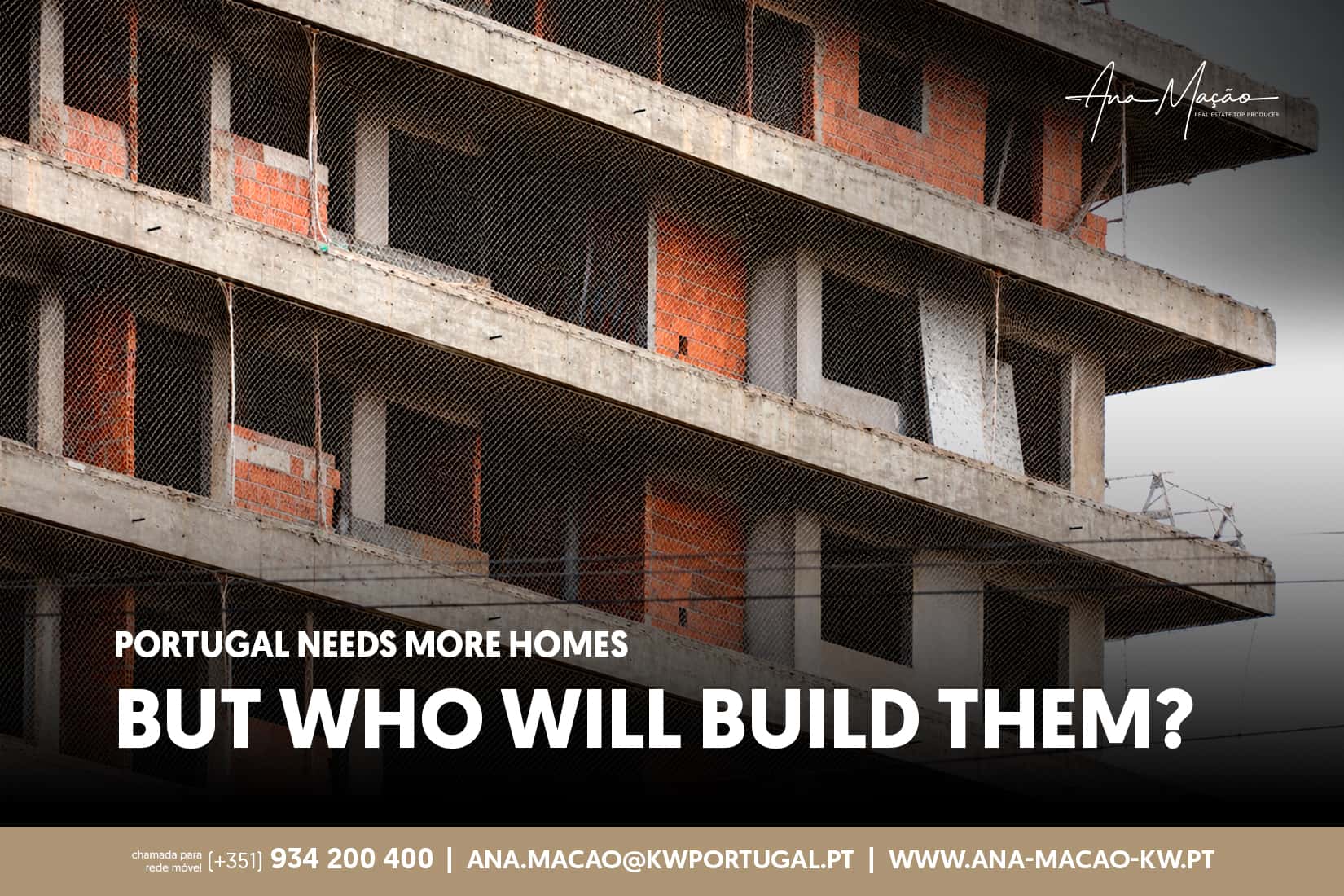
The lack of houses is no longer a theory
For years, the housing debate was stuck on the discussion of prices: expensive houses, high rents, and wages that don't keep up. All of this is true. But behind the prices lies a more basic reality: Portugal built too little for too long.

The country now faces a housing shortage that affects practically all high-demand regions, from Lisbon and Porto to the Algarve. The population growth (largely due to immigration), the reduction in average family size (which reduces the resident-to-housing ratio), international demand, and years of insufficient construction have created a difficult-to-ignore imbalance.
The question is no longer just about why prices have risen. The real question is understanding why there aren't enough houses to meet current needs.
Building more seems simple. In practice, it's not.

When discussing solving the housing crisis, the answer almost always comes immediately: more construction is needed.
But building a house remains a long, expensive, and complex process. For example:
- It is necessary to find available land, create projects, obtain approvals, secure financing, hire technical teams, find qualified labor, and ensure materials. All this before even starting construction!
- Many projects face delays due to lengthy licensing, high construction costs, or difficulties in finding companies capable of taking on new projects.
The result is simple: demand grows faster than supply.
The sector lost capacity over many years

After the financial crisis that marked the last decade, many construction companies reduced activity or disappeared. Thousands of workers changed professions or emigrated to other European countries.
Today, when there is a need to accelerate construction, the sector faces a reality different from that of 20 years ago.
In Portugal today, there are fewer companies, less available labor, and a growing need for specialization.
At the same time, current buildings require much higher standards in terms of energy efficiency, sustainability, safety, and construction quality. All this makes processes more demanding and increases pressure on a sector already working near its limits.
In other words, it's not enough for there to be demand. There needs to be capacity to meet it.
What is being done in Portugal?

In recent months, the topic of housing has gained unprecedented weight on the political agenda. The current government, as well as previous ones, have sought to create conditions to increase supply, simplify procedures, and encourage construction, but the results are not always as expected.
Among the most recent measures are tax incentives for housing, legislative changes related to land use planning, and new mechanisms aimed at accelerating construction and rehabilitation projects. But the response does not depend solely on the state.
Some municipalities are developing their own affordable housing programs (many of them funded by the PRR-European Recovery and Resilience Plan), providing municipal land and promoting new urban developments. Lisbon and Oeiras continue to invest in affordable rental projects, while other councils also seek to increase the supply available for residents.
At the same time, new models of collaboration between public entities and private investors are beginning to emerge, in an attempt to accelerate housing production without relying exclusively on state investment.
Private developers are starting to change strategy

Real estate developers are also adapting to the new reality.
One of the most interesting trends is the growth of the Build to Rent model:In the Build to Rent model, buildings are constructed specifically for rental instead of being sold apartment by apartment.
This model is already established in several European countries and is starting to gain traction in Portugal. The idea is simple: create a stable supply of rental housing through professionally managed projects designed for the long term.
At the same time, several companies are investing in industrialized construction systems and prefabrication. The Portuguese group Casais is a good example of this through its brand Blufab.
In industrialized construction, instead of producing all elements directly on site, a significant portion is manufactured in an industrial environment and later assembled on the ground.
This approach can reduce timelines, minimize waste, and increase cost predictability. It doesn't solve all problems, but it can help increase the sector's responsiveness. In this sense, the decree-law for the industrialization of modular construction is being regulated, aiming to simplify licensing procedures and ensure the technical compliance of these new construction solutions.
The 3 major obstacles still exist

Despite ongoing initiatives, there are 3 challenges that continue to hinder the increase in housing supply.
- Time: Even with administrative reforms, processes still take too long in many cases. We will see if the most recent legislative changes will be able to change this scenario.
- Labor: Construction needs to attract new professionals, with immigration being the most likely option. Investing in training and recovering part of the capacity lost over recent years.
- Economic viability: Building affordable housing in areas with high land costs remains a difficult equation for developers. This problem can only be overcome by expanding urban areas and strengthening the transport network. On the other hand, changes in cost structure will be necessary, such as increasing company size, accessing cheaper financing, investing in industrialization and modular construction, and reducing contextual costs.
Without addressing these 3 points, it will be difficult to significantly increase the number of houses available on the market.
What are other countries doing?

Portugal is not an isolated case. The difficulty in finding affordable housing is present in much of Europe and also in several countries outside it.
- In the United Kingdom, the government has set ambitious targets to increase housing construction, promoting changes to urban planning rules and seeking to expedite project approvals.
- In the Netherlands, there is a national plan to build hundreds of thousands of new homes by the end of the decade, with strong coordination between the central government and local authorities.
- Ireland is simultaneously investing in public housing, affordable housing, and incentives for private construction, seeking to diversify responses to the problem.
- In Spain, several initiatives involve providing public land, building affordable housing, and using state assets to increase supply.
Outside Europe, countries like Canada and New Zealand have invested in urban reforms, construction incentives, and new financing methods to try to respond to growing demand.
Despite differences between countries, there is a common conclusion: no single solution solves the problem. A combination of planning, investment, public construction, private participation, and process simplification is needed.
The right question is no longer "are there enough houses?"

The answer to that question is obvious: there aren't enough. The real question is another:
Who can build the houses we need, in the places where they are needed, at a sufficient pace and at prices compatible with family incomes?
The answer will necessarily involve the state, municipalities, developers, construction companies, investors, and the citizens themselves.
Building more houses doesn't just mean erecting buildings. It means creating conditions for the entire chain to function better: planning, licensing, financing, labor, infrastructure, and trust.
Without that, we will continue to discuss prices in a market where supply always arrives later than demand.
In the end, the housing crisis can be summed up in a simple sentence: Portugal needs more houses, but above all, it needs to regain the ability to build them.