

The square meter in Lisbon has already exceeded five thousand euros. In areas like Campo de Ourique or Estrela, a one-bedroom apartment in acceptable conditions hardly goes below four hundred thousand.
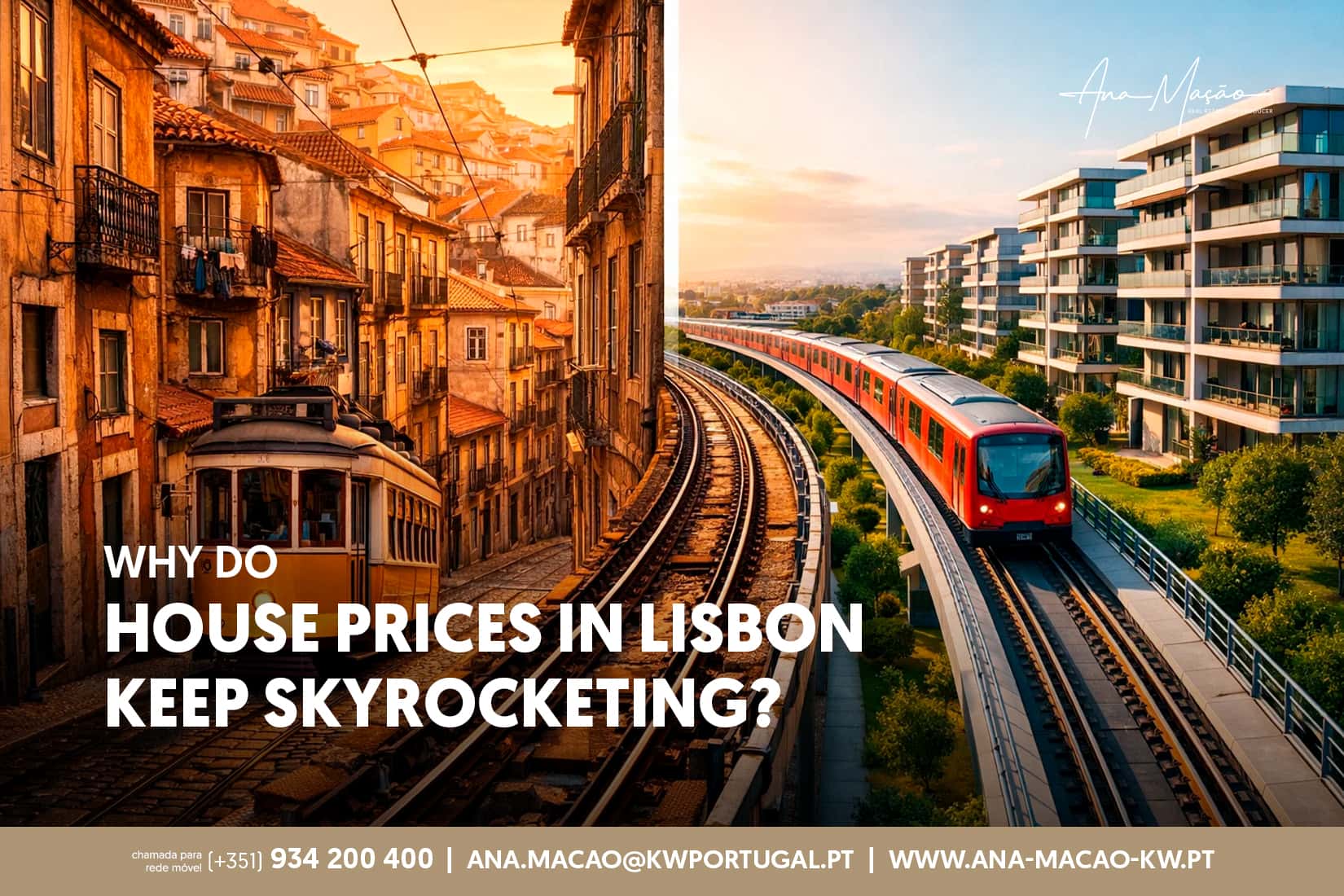
And no, this is not explained just by the word "speculation." The origin of the problem is older and quite straightforward: increased demand and supply scarcity.
This article reflects my view on the real estate market in Lisbon, compared to other European capitals, and the solutions I consider more appropriate than simply building, building, and building, without considering where or how.
Context: new historical highs
The data from the National Institute of Statistics, published by Público, help to understand the current moment. In the third quarter of 2025, the median house price in Portugal reached new historical highs.
For the first time since records began, the national value exceeded €2,100/m², with an increase of 16.1% compared to the same period of the previous year.
Lisbon stands out clearly. The median price reached €5,000/m², up 15.3% in a single year. Cascais follows with €4,713/m² and Oeiras shows an even more significant increase, around 22%.
The pressure is not felt only in the capital. Prices rose in all 26 sub-regions of the country and only 37 of the 308 municipalities recorded declines. In Greater Lisbon, the average increase was 17.6%.
There is another factor affecting the market: foreign buyers pay much higher prices, with a national average that is 35% above what residents pay. In Greater Lisbon, it reaches 61.7% and in Funchal, the difference is 51%,

Faced with these numbers, the question almost arises on its own: why do house prices in Lisbon keep skyrocketing? And, right after, another even more relevant: what can actually help bring these values down?
The problem in numbers: a decade of little construction
You don't need to be an economist to understand the basics. When many people want to buy and there are few houses available, prices rise. In recent years, the construction of new housing in Portugal, especially in Greater Lisbon, has fallen far short of demand.
The population has increased. Immigrants have arrived looking for work. Foreigners and investors have come to see Portugal as a safe haven. Many Portuguese who previously left for abroad or the interior are now trying to stay or return.
According to the Associação Alojamento Local Porto e Norte (ALPN), which prepared a "technical diagnosis" on the housing situation in Portugal, recently sent to the Government and to Brussels:
The crisis results from the prolonged collapse of housing supply since 2010" and there is "an accumulated deficit of over 870,000 homes" in the country and that AL "has a marginal aggregate impact and does not explain the housing shortage"
The result of all this? More buyers, fewer houses on the market, and prices always rising. The math is simple.
The false promise of building more in the center
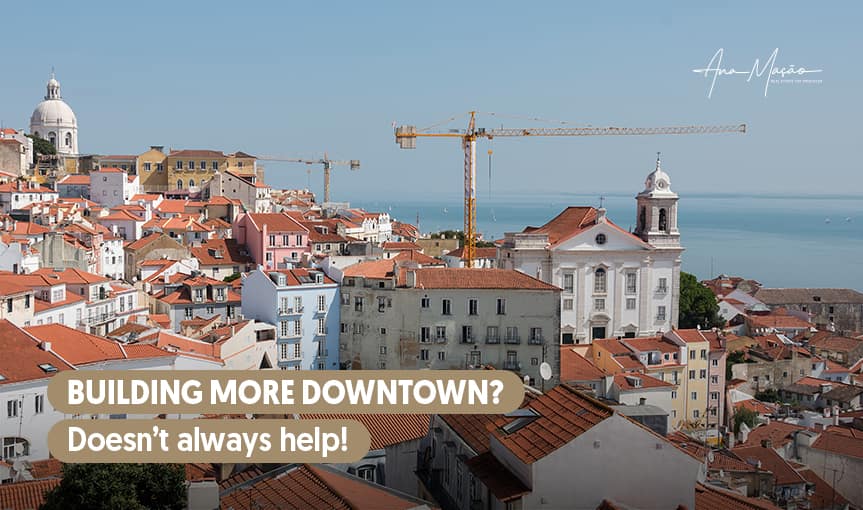
It is often said that the solution is to accelerate construction in the centers of large cities, like Lisbon. If there is little supply, build more. At first glance, the logic seems obvious.
In practice, it is not quite like that. There are two reasons that help explain:
- The first is related to the concentration of demand. Most people do not look for "Lisbon" in the broad sense. They seek the historic center, proximity to the metro, services at the door, and neighborhood commerce. Building more in already expensive areas ends up creating more product for those who already have financial capacity.
- The second is related to the cost of land. In the center, each square meter costs very high values. A developer who invests millions in a lot will not put affordable housing on the market. They will position the project in the segment that allows them to recover the investment.
It's the market logic at work, without great romanticism.
Have you noticed how many new buildings in the center almost all follow the same pattern? Modern facades, lots of glass, and prices that do not fit Portuguese salaries.
The lost war against luxury

Some argue that the way forward is to curb luxury construction or limit local accommodation. The idea seems sensible. Luxury is prohibited and these houses are redirected to the general population.
The problem is that this is often an unproductive war. Banning the luxury segment does not create affordable housing. In many cases, it only deters investment or leads developers not to build. We all remember the dilapidated state of some neighborhoods near the historic center of Lisbon....
In the case of local accommodation, the effects were not linear either. In several areas, rents did not fall. Part of the properties just changed audience or remained empty waiting for better conditions.
Luxury and tourism are symptoms of a pressured market. They are not the main cause.
What works in Europe: three examples to consider
There's no need to invent anything new. Other European capitals have faced similar problems and found practical solutions.
Paris and the RER
Paris invested in a robust regional network, the RER, which connects the center to a metropolitan area with millions of inhabitants. The frequency of this transport is high and trips from more distant areas rarely exceed 45 minutes.
The effect was direct. Previously undervalued communes became real alternatives for the middle class. Prices in Paris remain high, but the region offers options. And the transport is reliable, not dependent on traffic.
When was the last time the Cascais Line operated without delays for several consecutive days?
Munich and the dispersed city
Munich is organized around the S Bahn, a high-frequency suburban network. It is possible to live 40 or 50 kilometers from the center with regular and predictable connections.
Those who live outside do not speak of sacrifice. They speak of choice. And prices in those areas can be 30% to 40% lower.
Copenhagen and planning
Copenhagen imposes clear rules. Large office hubs can only be built near public transport. The city grows around these corridors, without creating isolated neighborhoods.
Lisbon, at many moments in its recent history, grew without this care. It grew and spread without ensuring appropriate connections.
The solution for Lisbon: where and how
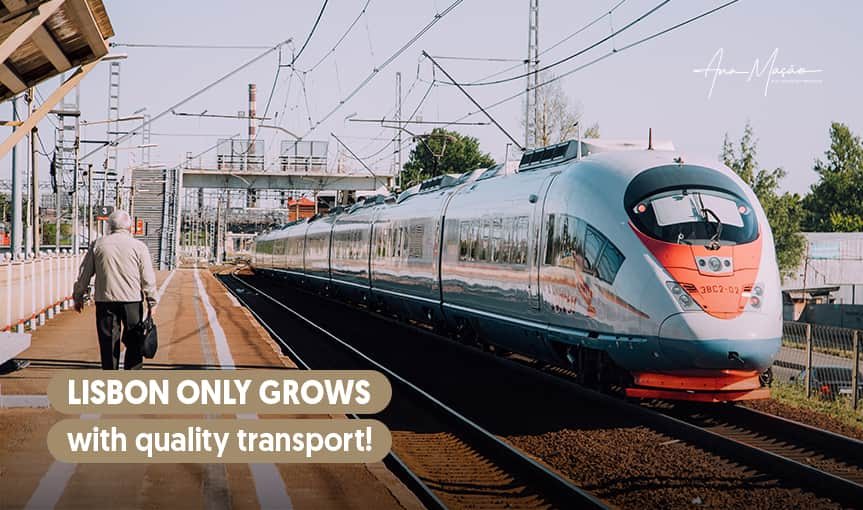
If these examples work, what prevents Lisbon from following the same path? It's not a lack of money. It's a lack of priority and joint vision.
Surface metro for Cascais
The Cascais Line is a clear example of wasted potential. Today it is slow and unreliable. It could function as a true metropolitan connection.
With higher frequency and shorter travel times, as well as more parking near stations, Cascais, Estoril, and Oeiras would become real alternatives for those working in the center, easing traffic pressure on Lisbon.
The SATU in Oeiras failed, but the basic idea was not wrong. It lacked scale and integration.
Connection Sintra, Loures, and Odivelas
Sintra has an old and slow line that does not keep up with urban expansion. Loures and Odivelas have grown heavily dependent on cars.
An efficient connection between these points would open new areas for housing and clearly improve accessibility.
The South Bank axis
The South Bank remains an unfulfilled promise. Thousands of people cross the bridge daily due to a lack of viable alternatives.
With fast and integrated connections, areas like Trafaria or Alcochete would no longer be seen as too far away.
A metropolitan network
It's not enough to have lines that go in and out of the center. A network that connects municipalities to each other would allow living in one municipality and working in another without always passing through Lisbon.
What is missing: coordination, political will, and money...

It is often said that the solution is to accelerate construction in the centers of large cities, like Lisbon. If there is little supply, build more. At first glance, the logic seems obvious.
From a technical point of view, almost all of this is possible. There are available corridors, installed capacity, what fails is coordination. Each municipality follows its plan, without an integrated metropolitan vision. Isolated projects end up not solving the underlying problem.
A metropolitan entity with real power, similar to what exists in Paris, would make all the difference. Less local discussion, more regional vision.
Where money doesn't reach and opportunities are lost
The financial scale of these heavy infrastructure projects is, in itself, an insurmountable barrier solely through municipal budgets. Opening tunnels, electrifying new lines, or purchasing modern rolling stock requires investments that only the State, with direct support from Brussels, has the capacity to sustain.
Without the State at the helm, these expansion plans are just good intentions. Municipalities do not have the financial stamina for works that cross several municipalities and require very complex coordination. We also cannot expect the private sector to take on the risk alone. Without guaranteed and very high revenues, it is unlikely that there will be companies willing to set up a network of this scale on their own.
The PRR and the European recovery funds were our great historical opportunity. Unfortunately, it seems we are letting this train pass without taking advantage of its true structuring potential.
Although funds were allocated for mobility, the absence of an integrated strategy meant that the money was scattered in projects of lesser impact or in less ambitious surface solutions. These "unique" financial resources could have been the engine of a real railway revolution, but they often ended up filling punctual gaps, losing the opportunity to equip Lisbon with a network comparable to major European metropolises.
CONCLUSION
House prices in Lisbon will not decrease by decree. They will also not decrease just because more is built in the center, which can even push the average prices up.
Banning luxury does not create affordable housing. In many cases, it only reduces construction, exacerbates the imbalance, and wastes a source of revenue for the country and municipalities.
The most consistent way out is to expand the city through a network of quality public or private transport. A Lisbon that extends to Sintra, Mafra, Loures, or Setúbal, without that being synonymous with remoteness.
Until this vision gains strength, €5,000/m² may end up seeming normal. And that is perhaps the most unsettling sign of all.